
Skills vs strategy
Before the Bulls started dominating in 1990, many say Michael Jordan had his best season in 87/88. He took the MVP title and even broke the All-star record scoring at least 40 points nine games in a row.
But it wasn’t until Phil Jackson became the main coach of the Chicago Bulls, that the Bulls started winning the NBA finals.
It’s true, being a sales equivalent of Michael Jordan, can bring you really far, but you won’t experience true greatness until you embrace the fact that Sales is more than playing the one-on-one game.
Phil Jackson made the Bulls go from good to great, by having a strong Team Strategy that was less dependent on Michael Jordan, and able to adjust tactics to take on any opponent (including those dreaded Pistons).
I realize that this is contrary to what many believe the job of a sales rep or account executive is. Sales are there to score, right?
We are not there to think team strategy, or are we?
Here is the truth on that matter, in B2B sales it’s very unlikely the purchasing decision will be made by one person. In fact, many studies have shown the number of persons involved in a buying decision to increase with deal size.
Whether your particular opportunity has just five or as many as ten decision-makers involved, the fact is you’ll need to manage multiple customer stakeholders, and you’ll need to use multiple teammates to do so effectively.
Time after time I have seen great sales professionals lose out of deals by:
- Focussing on only one “champion” within the customer organization
- Not understanding how the complete buying process functions
- Not having a clear picture of all stakeholders that influence the buying decision
- Not using teammates and their customer contacts
- Being flanked by competitors that have contact with high-level decision-makers
Not using a solid team strategy in sales will make you step on those landmines, regardless of how good a “seller” you are.
B2B sales done without strong stakeholder management is like the Bulls depending solely on a great Michael Jordan, missing out on the NBA title three years in a row. Losing from the Pistons time after time until they finally shifted.
As said, the Bulls started winning finals when they focussed less on Michael Jordan and took on Phil Jackson to focus more on team strategy and tactics. In my opinion, even Jordan started playing better basketball, being part of an overall better team.
That being said, aren’t we lucky? In sales, we get to play Michael Jordan and Phil Jackson if we choose to!
Here is how you can take sales to a whole new level by using the Customer Team Management (CTM) Plan.
The Customer Team Management Plan
To win the game of sales we must manage the game. If you’d like to read more on how to manage the sales game using the Mutually Agreed Action Plan, check out this article here.
But to win the game we also manage the players.
That’s where the Customers Team Management (CTM) Plan, comes in.
CTM is not about randomly socializing with the customer and being best friends with all the people involved in your project.
Although I highly encourage you to have meaningful personal contact with your customers on a regular basis, CTM is more about strategic insights than it is about effective communication.
As such, I encourage you to implement the project engineering approach to stakeholder management.
To identify all key stakeholders and decision-makers, to make sure you understand their different roles, how they influence decision-making, and how you can effectively communicate to every single one of them.
It goes without saying, that if you are already an effective relationship builder and enjoy the personal interaction with your customers, taking a structured approach to CTM will level up your game exponentially.
However, if you are not an extrovert, working your CTM plan will make sure you’ll only speak when you have something relevant to say, ensuring your communication style will be put to really good use. The reason why it’s called Customer Team Management and not Stakeholder Management as they do in project engineering is twofold:
- Customer Team, because amongst the stakeholders and the decision-makers, different roles within the Customer Team will impact the buying decision in different ways, sometimes their interests are conflicting, but you still need them all to be there and reach a consensus. And,
- Management, because it’s your duty to actively steer all stakeholders and decision-makers to reach a consensus.
“It’s your job, to make sure all customer team members have their noses pointing in the same direction (preferably your direction).”
Ideally, you actively guide them to reach a consensus on the problem definition, why they want to solve it, and who they want to solve it with.
All your company’s efforts would then lead to a common understanding, that your offering is the best fit for the job at hand.
This is what a CTM Plan could look like:
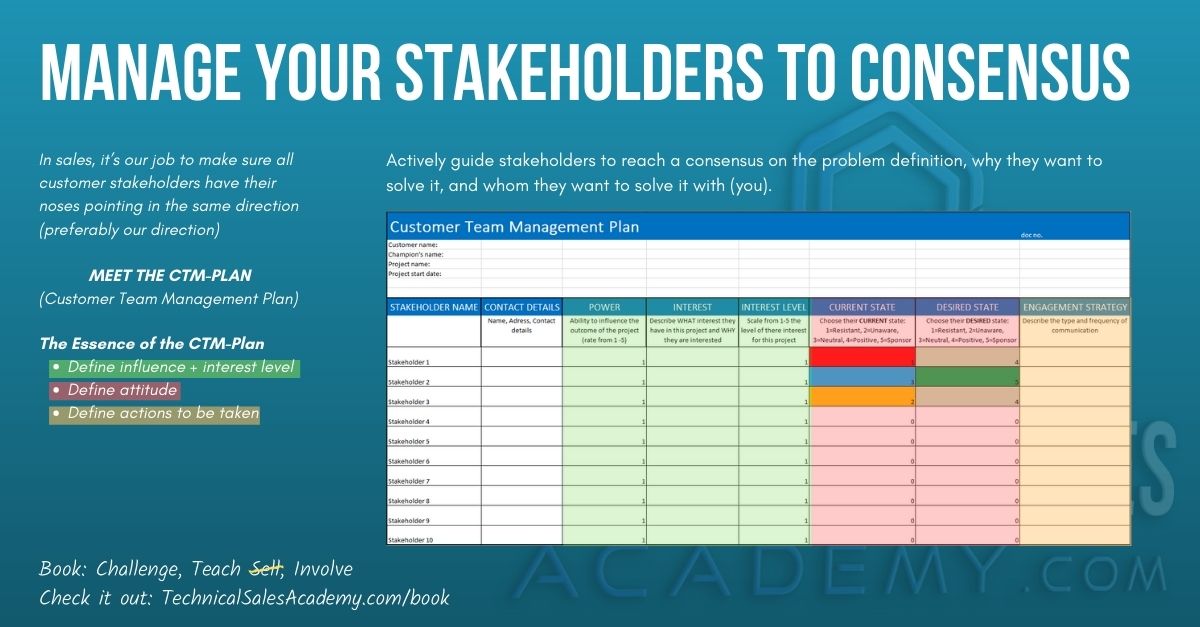
It’s a spreadsheet that helps you identify your stakeholders, rate their current power and influence, interests, and attitude levels, as well as define actions to manage each stakeholder towards the desired state.
Take your sales to the next level: Sell using subject matter expertise
The actions you take throughout the sales process will contribute to creating the Customer Team Consensus, but it is the CTM Plan that will enable you to see if things are on the right track and identify possible potholes.
If you’d like to know more about how to set up and use the Customer Team Management Plan, and other awesome subject matter expert (SME) selling techniques, be sure to check out my LIVING book: Challenge, Sell Teach, Involve.
Wonder why it’s called a LIVING book?
It’s a digital book that lives inside an online learning environment and keeps evolving in time. The book gets updates frequently, either in additional content added or in updating existing content to make sure everything stays relevant.
It’s isn’t a regular book either, it contains pictures for sure, but it also contains all templates used within the book. It even has instructional videos on how to use templates like the CTM Plan correctly!
So if you’d like an ultimate book on Sales using Subject Matter Expertise, a book that grows as you grow, be sure to check out:
Challenge, Sell Teach, Involve
***
Thanks for reading. If you found it useful, please do share. I spent many, many hours on these articles so it would be nice if a few people actually read them.
If you don’t want to miss more articles (like this one), guides & case studies please do join my newsletter.
Take care — Mohamed Ali