Introduction
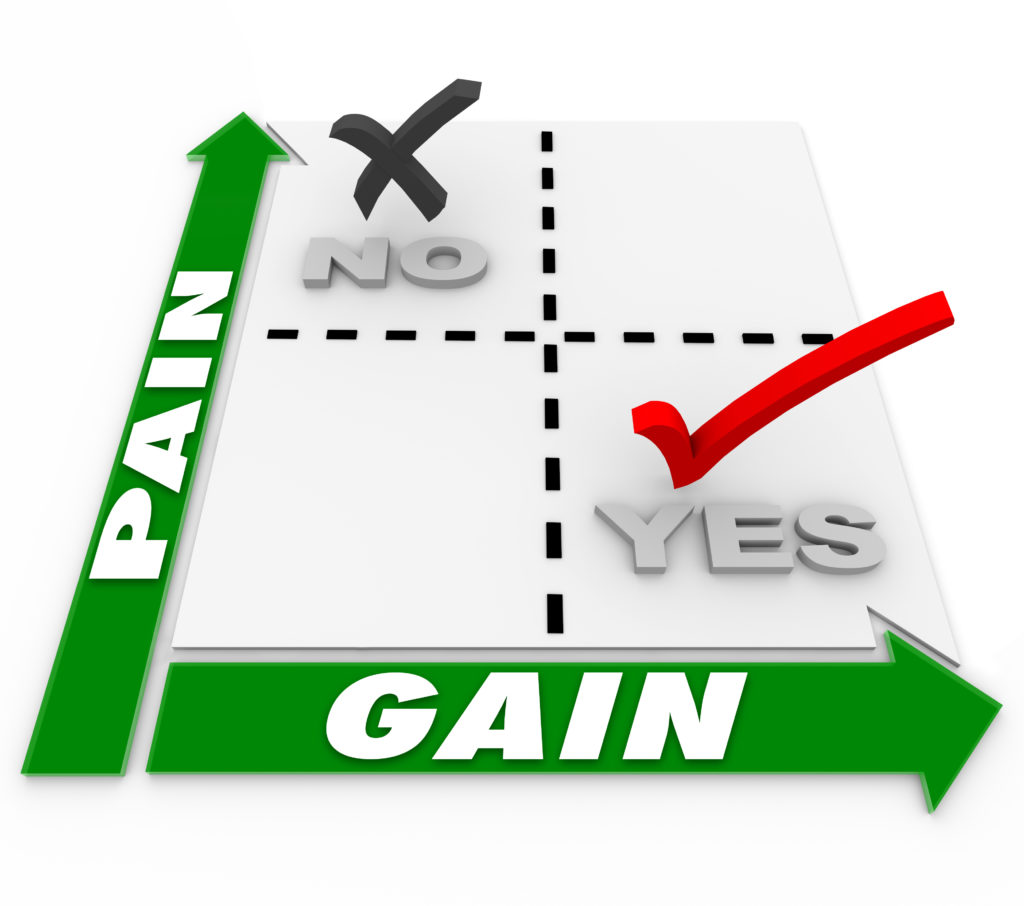
In this article, we take a look at the theory behind the classic sales perception of human motivators, PAIN and GAIN.
Having dwelled on PAIN for the majority of my sales life, an alternative approach has opened my eyes and broadened my horizon. Enjoy the read!
Before we go any further, the focus on PAIN in sales is a tried and tested strategy that will help you land opportunities. In fact, to date, I believe it’s the most effective strategy to have maximum results, in the least amount of time.
However it is not the only way success can be had, and in my opinion, it isn’t necessarily the most enjoyable one either. I’ll show you why in a minute, but first, let’s explore why focusing on PAIN is such a successful strategy in sales.
PAIN
To kick this article off, let’s hear from two sales superstars:
Linkedin influencer Belal Batrawy:
“Our brains are hardwired to avoid loss. That’s why loss aversion is 2X more powerful than the pleasure of gain.”
Keenan, author of the best-selling book, GAP Selling:
“The root cause is the technical problem you solve. People don’t buy to fix root causes. They buy to avoid the negative impact the technical problems are causing.”
Psychologic Godfather of the pain-pleasure theory Sigmund Freud, suggests that people make choices to avoid or decrease pain or make choices that create or increase pleasure. According to him, the pain-pleasure principle is the core of all the decisions we make.
The reason why PAIN is such an effective motivator in sales and many sales gurus swear by it, is the fact that a big PAIN needs to be resolved NOW, vs GAINS can be POSTPONED.
A preventing PAIN task never goes away, if we don’t do them, someone will bring it to our attention — even if that someone is ourselves.
By focusing on PAIN, we leverage that psychological push in the back.
In 70% of all sales opportunities I have successfully landed, PAIN was the major motivator.
A big PAIN brings urgency and priority in the mix. These two ingredients speed up the buying process and thereby the sales cycle considerably. Shorter sales cycles tend to have higher success rates.
Some studies claim PAIN to be a 3x stronger motivator than GAIN. It is known it is relatively easy to trigger the limbic brain using PAIN. The limbic brain is the portion of your brain that’s responsible for your emotions. In fact, the limbic brain is stimulated 3000 times faster than your neocortex, which is the part responsible for logical reasoning.
In B2B sales, it’s so easy to find PAIN. Most departments have metrics that measure PAIN, especially purchasing departments. The major buying KPI’s focused on cost, quality & delivery performance all relate to PAIN.
So using PAIN to help develop buying motives, has been and will be a solid strategy in sales.
GAIN
However, I am still a fan of selling based on GAINS, especially when selling on a strategic level. Sales cycles tend to be longer, but the relationship quality that arises from this kind of opportunity is on another level.
As you might know already, I preach using subject matter expertise as your base skill in sales. The focus on GAIN, provides some unique opportunities to shine as an SME.
GAIN opportunities provide an open environment to explore creative solutions that can be developed in close cooperation with customers, leading to a partner-level relationship even before the deal is closed.
But in order to use GAIN selling effectively, you still need to trigger that limbic brain. You need a buyer that dwells on success.
I’ve found two kinds of buyers that respond particular well to the GAIN approach:
- The c-suite and other strategic roles
- Personnel responsible for the development and implementation of future products/services
These buyers have KPIs based on GAIN, to increase revenue, make products better, etc.
The reason why I still use PAIN in the majority of opportunities (70%), is the fact that GAIN selling can be a bit risky. Longer sales cycles bring additional risks, and you’ll have to rely heavily on good qualifying skills to keep your success rate at the desired level.
I think it’s because of the above-mentioned reasons that it took me a while to find someone else with similar experiences in GAIN selling, but then I stumbled upon a quote from former Fortune500 Chief Financial Officer Jack Dean:
“ I actually like the concept of solution selling because it begins the process of shifting a sales professional’s mindset from selling product features to thinking from the customer’s perspective. But, the solution selling mantra of NO PAIN NO CHANGE is curiously negative and counter to the positive, can-do thinking of many executives. As I describe in my blog post Got Pain?, executives are by nature driven to achieve success. They don’t dwell on pain; they don’t plan around pain; they don’t motivate their team by talking about pain; and they certainly don’t want a sales person interrogating them about their company’s pain points.”
Fascinated by what drives human motivation and ultimately decision making, I set out to understand the psychologies behind them.
Maybe there is more to it than just PAIN or GAIN?
In researching why PAIN or GAIN selling can work, I found E.Torry Higgins’s book, Beyond Pleasure and Pain: How Motivation Works.
Torry Higgins, says:
“ To understand human motivation, it is necessary to go beyond pleasure and pain. What people want is to be effective in their life pursuits, and there are three distinct ways that people want to be effective.
- They want to be effective in having desired results (value), which includes having pleasure but is not limited to pleasure.
- They want to be effective in managing what happens (control)
- and in establishing what’s real (truth), even if the process of managing what happens or establishing what’s real is painful.
These three distinct ways of wanting to be effective go beyond just wanting pleasure, but there is even more to the story of how motivation works. ”
Since I started focusing on helping my buyers to be more effective in achieving their goals, I’ve found my PAIN and GAIN approaches to become much more solid.
Fast forward a couple of years, value, control & truth lie at the heart of everything that we teach inside this academy. Our aim is to help customers be more effective in achieving their goals through the usage of our unique SME insights and leadership.
If you want to know more about SME selling, and how subject matter expertise can be leveraged to increase your sales effectiveness, be sure to check out my book: Challenge, Teach, Involve.
PAIN vs GAIN, pick a side
To round up this article, I want to leave you with some final thoughts on PAIN vs GAIN selling.
If you’re in it to win it and want results short-term, better stick to the No PAIN, No Gain matra.
But if you want to mix up your sales a bit, invest in long term business relations, enjoy the marathon sales cycles, you might want to following advice given by a famous long-distance running coach:
“I have a saying train, don’t strain. The Americans have the saying no pain, no gain and that’s why they have no distance-running champions. They get down to the track with a stopwatch and flog their guts out thinking that it’ll make them a champion, but they’ll never make a champion that way.”
– Arthur Lydiard –
***
Thanks for reading. If you found it useful, please do share. I spent many, many hours on these articles so it would be nice if a few people actually read them.
If you don’t want to miss more articles (like this one), guides & case studies please do join my newsletter.
Take care — Mohamed Ali